
It’s time again to look to the skies.
The Leonid meteor shower peaks this week. The Leonids are an annual fall meteor shower active between Nov. 6 and 30, peaking on the evening of Nov. 17. They are one of the most prominent meteor showers of the year, considered to be some of the fastest meteors and often known to be colorful, according to NASA.
Related video above: See the moment a meteor lights up the sky above an erupting volcano
This year, we can expect to see anywhere from three to 15 meteors per hour. But though it won’t happen this November, the Leonids are also known to make a roaring comeback every 33 years, coinciding with the orbital period of the comet that they originate from, 55P/Tempel-Tuttle. And when Tempel-Tuttle is near enough to Earth, it can cause a meteor storm, which is when more than 1,000 meteors can be seen in just an hour.
The Leonids are hundreds of years old, and the meteor storms have been seen several times across recorded history.
According to NASA, the earliest observation of the Leonids was in 902 A.D. when Chinese astronomers and observers in what is now Egypt and Italy reported seeing the first meteor storm from the Leonids. Accounts of the storm varied, but the sentiment was the same: “Stars fell like rain.”
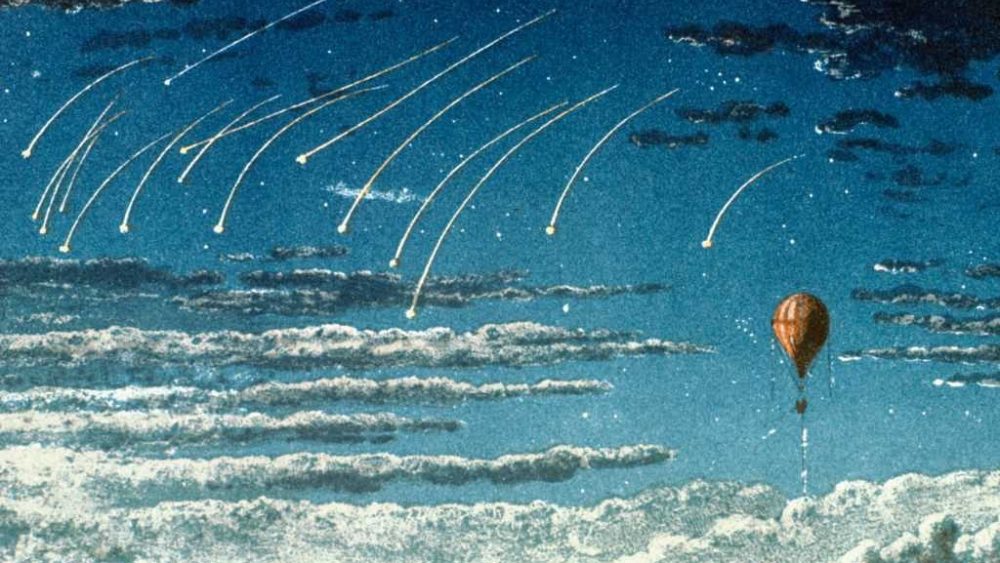
Perhaps the most famous Leonid meteor storm in the modern era was the storm of 1833. The storm was so severe that one estimate stated that over 240,000 meteors were observed overnight. The engraving above appeared in an 1844 edition of “Bible Readings for the Home Circle,” a Christian reading guide that sought to answer many questions about the world for followers of Christian thought. One such question accompanying the picture in a section titled “Sign of the Times” was: Could this shower foreshadow the second coming?
An answer quotes the physicist and astronomer Denison Olmstead, writing, “The extent of the shower of 1833 was such as to cover no inconsiderable part of the earth’s surface … This is no longer to be regarded as a terrestrial, but as a celestial, phenomenon; and shooting stars are now to be no more viewed as casual productions of the upper regions of the atmosphere, but as visitants from other worlds, or from the planetary voids.” Olmstead would come to be known as the father of “meteor science” after the intense Leonid storm of 1833 spurred him to better understand the elusive phenomenon.
The shower of 1833 was also notably seen over Niagara Falls, inspiring several paintings and woodcuts.
Also in 1833, explorer and writer Josiah Gregg chronicled his time with Indigenous tribes along the Santa Fe Trail. Gregg spent time with the Cheyenne tribe, including during the Leonid meteor storm. Gregg wrote that the Cheyenne sacrificed a white bison on “The Night the Stars Fell” and wrote a peace treaty with the U.S. on its skin.
The radiant of the Leonids is the constellation Leo. The shower is visible in the eastern night sky after midnight. Also, Jupiter and Mars will be in conjunction near Leo the same night, just above Regulus, one of the brightest stars in the sky.
The latest Leonid meteor storm took place in 2002. According to NASA, comet 55P was independently discovered by both Ernst Tempel and Horace Tuttle just a year apart, in 1865 and 1866, so it was named for both of them.
Leonid meteor storms aren’t always exactly 33 years apart. Certain conditions have to be met to cause a significant storm, usually involving clouds of debris that follow the comet’s orbit. From 1998 to 2002, the solar conditions were so unique that they caused several storms in a row, producing around 3,000 meteors in an hour at times. Before 1998, the most recent storm was in 1966.
Unfortunately for us, the next predicted dense meteor storm is actually in 2099, though the 2033 and 2034 Leonids could show off a significant stream of anywhere from 30 to 500 meteors per hour.


